Health Care

Health Care, a Plan

health care

Our administration and representatives are negotiating the terms to take over our health care system, in the belief that it is too expensive, and will cripple our economy if the costs are not controlled.  The human element is the plea to cover people that do not have insurance, so they will have access to the best care money can buy.

Rather than plow ground that has been plowed by writers more gifted than I, my focus is how to provide health care to uninsured citizens.  If this is a national priority, let's not destroy the health care system that stands between us, and the grim reaper in the process.

As a former County Commissioner, I had the responsibility to oversee and fund the county health department.  This health care facility provided basic services to many who could not afford (or chose not to pay for) access to private care.

County health departments exist throughout the nation, working quietly to benefit society's poorest citizens.  Free or reduced price, health care is already being provided depending on your ability to pay.

The present discussion is about building a new bureaucracy and restricting health access for everyone.  Why not increase the funding for County Health Departments around the nation?

In exchange for this added charitable benefit, the uninsured could only be treated at hospital emergency rooms after hours, and only if hospitalization was required.  Hospitals would bill the county health department for any services provided, at the lowest negotiated group network price.  Hospital emergency rooms would no longer be required to accept anyone who walked in their door.

Funding should be allocated by population on numerical bases, and disbursed to each congressional district.  The Federal Government's role would end at this point.  Each Congressional District would have a local board, composed of one commissioner from each county.

These district boards would be responsible to distribute the funds to each County Health Department for the best impact in their area.  County Health Departments would have to expand to enhance services, but continue to provide basic health services for the uninsured or poorest citizens.

To access these services, citizens would have to:
  • Prove citizenship (are we going to provide free health care to THE WORLD?)
  • File a copy of last year's 1040 (verifies income)
  • Prove residency (avoids shopping location)
  • Develop other local regulations sensitive to local voter wishes.
To increase insurance participation, let individuals deduct insurance premiums up to $3,600 per head of household, and $2,000 per dependent on their federal taxes.  Let companies deduct insurance benefits on the same schedule.

Require insurance companies to accept citizens with pre-existing conditions.  This would have two caveats:
  •  90 day exclusion period if the pre-existing condition was not covered by insured's previous policy, or if they did not have insurance.
  • Citizens would not be able to "insurance shop" for better coverage on pre-existing conditions.  Previous coverage would apply for 90 days on any pre-existing condition.
In exchange for society offering this benefit, health care has become a responsibility to everyone.  If society is providing "free" care to the poorest citizens, then those that can afford health insurance must be required to:
  • Purchase basic insurance in the open market, or
  • Pay an insurance surcharge on their federal income tax return of 25% the maximum health insurance deduction available to those that buy insurance.
With this health reform plan, we accomplish a few beneficial goals, and avoid some the worst outcomes.
  • The costs are clearly stated in the federal budget, as a transfer to congressional districts for health care.
  • We stop health care for non-citizens.
  • We eliminate cost shifting onto insurance premiums.
  • The health care benefit is restricted to county health departments, and basic health care. 
This benefit is not intended to grant access to the "best health care money can buy" for everyone, but to put in place a safety net under our poorest citizens, until they get back on their feet and can afford the health care they would like for themselves and provide for their families.

Some may have a concern about the exclusion of non-citizens in our coverage by the nation's taxpayers.  If a non-citizen seeks medical assistance at any county health department or hospital, they must first sign an "agreement to deportation" document.

After being treated, they will be immediately deported by the County Sheriff.  The county health department will fund the cheapest transportation to a hospital in their home country.

A few general points need to be emphasized:

  • Health care is expensive because of government expanding coverage to new illnesses: i.e.: alcoholism, mental illness.
  • Health care is expensive because of tort lawyers.
  • Health insurance is expensive because of low deductibles. 
Addressing these three issues will slow the growth in health care costs. Removing non-payers from the health care system will eliminate cost shifting, lowering health care costs to everyone.

Medicare and Medicaid should be required to pay the lowest negotiated network price for any services.  This would further reduce the cost shifting that currently distorts the market.  It also sets reimbursements at a localized cost rate, rather than a one-size-fits-all standard.  It takes the power away from the government to promise more and pay less by force.

A side note:

If Oh! Bama is successful in gaining a public option for health insurance; it must be a standalone agency without any support from taxpayers.  Wouldn't it be fun to watch bureaucrats try to compete with private insurance companies?  I always laugh when politicians say the government needs to "keep the insurance companies honest."

Government subsidies should be equal to the "premiums" they do not collect from citizens covered.  In other words, only the premiums would be subsidized by the government.  The public option (government bureaucracy) would have NO legislation that tilted the playing field for them to compete.  They would have to negotiate fees with health care providers, just like everyone else.  If they did not pay fairly, providers could choose not to do business with them.  With an absolute wall to legislation or money, this charade would be over quickly and we could return to a free market.

By: John Dalt

Why Did Energy Expenditure Differ Between Diets in the Recent Study by Dr. Ludwig's Group?

As discussed in the previous post, a recent study by Dr. David Ludwig's group suggested that during weight maintenance following fat loss, eating a very low carbohydrate (VLC) diet led to a higher metabolic rate (energy expenditure) than eating a low-fat (LF) diet, with a low glycemic index (LGI) diet falling in between the two (1).  The VLC diet was 30 percent protein, while the other two were 20 percent.  It's important to note that these were three dietary patterns that differed in many ways, and contrary to claims that are being made in the popular media, the study was not designed to isolate the specific influence of protein, carbohydrate or fat on energy expenditure in this context. 

Not only did the VLC diet lead to a higher total energy expenditure than the LF and LGI diets, the most remarkable finding is that it led to a higher resting energy expenditure.  Basically, people on the VLC diet woke up in the morning burning more energy than people on the LGI diet, and people on the LGI diet woke up burning more than people on the LF diet.  The VLC dieters burned 326 more calories than the LF dieters, and 200 more than the LGI dieters.

It's always tempting to view each new study in isolation, without considering the numerous studies that came before it, but in this case it's essential to see this study through a skeptical lens that places it into the proper scientific context.  Previous studies have suggested that:
  1. The carbohydrate:fat ratio of the diet has little or no detectable impact on energy expenditure in people who are not trying to lose weight (2, 3).
  2. The carbohydrate:fat ratio of the diet has little or no detectable impact on energy expenditure in people who are being experimentally overfed, and if anything carbohydrate increases energy expenditure more than fat (4, 5).
  3. The carbohydrate:fat ratio of the diet has little or no detectable impact on energy expenditure during weight loss (6, 7, 8), and does not influence the rate of fat loss when calories are precisely controlled. 
This new study does not erase or invalidate any of these previous findings.  It fills a knowledge gap about the effect of diet composition on energy expenditure specifically in people who have lost weight and are trying to maintain the reduced weight.

With that, let's see what could have accounted for the differences observed in Dr. Ludwig's study.
Read more »

New Study: Is a Calorie a Calorie?

A new study in JAMA led by Dr. Cara B. Ebbeling and colleagues purports to challenge the idea that all calories are equally fattening (1).  Let's have a look.  When thinking about the role of calorie intake in body fatness, there are basically three camps:

1.    Calories don’t matter at all, only diet composition matters.
2.    Calories are the only thing that matters, and diet composition is irrelevant.
3.    Calories matter, but diet composition may also play a role.

The first one is an odd position that is not very well populated.  The second one has a lot of adherents in the research world, and there’s enough evidence to make a good case for it.  It’s represented by the phrase ‘a calorie is a calorie’, i.e. all calories are equally fattening.  #1 and #2 are both extreme positions, and as such they get a lot of attention.  But the third group, although less vocal, may be closest to the truth. 
Read more »

Wacky Facts Wednesday - Bone Count


An adult has fewer bones than a baby. We start off life with 350 bones, but because bones fuse together during growth, we end up with only 206 as adults.

Look Better - Feel Better - Live Better
~ Sue

What Puts Fat Into Fat Cells, and What Takes it Out?

Body fatness at its most basic level is determined by the rate of fat going into vs. out of fat cells. This in/out cycle occurs regardless of conditions outside the cell, but the balance between in and out is influenced by a variety of external factors.  One of the arguments that has been made in the popular media about obesity goes something like this:  


A number of factors can promote the release of fat from fat cells, including:
Epinephrine, norepinephrine, adrenocorticotropic hormone (ACTH), glucagon, thyroid-stimulating hormone, melanocyte-stimulating hormone, vasopressin, and growth hormone
 But only two promote fat storage:
Insulin, and acylation-stimulating protein (ASP)*
Therefore if we want to understand body fat accumulation, we should focus on the latter category, because that's what puts fat inside fat cells.  Simple, right?

Can you spot the logical error in this argument?

Read more »

Join An Online Support Group.


Tuesday’s Tip #3


It’s essential that you not feel alone, and reaching out to friends (new or old) is typically a smart move. 

I just heard about My Fitness Pal, but didn’t know about it when I began down the road to weight loss. 

You have to know that others are out there for moral support – they know things that you couldn’t possibly know, and they’ve probably been “in your shoes” at some point in the past (or present). 

Share stories, laughter, tears, successes, and failures – share them. 

There are thousands of communities out there, so keep looking until you find the one that fits you.


Look Better - Feel Better - Live Better.
~ Sue

Motivation Monday: Get Up and Move


Rise and grind my friends!

It’s MONDAY, and y’all know what that means…. It’s time for yet another instalment of ”Motivation Monday” where I share with you my thought/motto/mantra for the week.


I know the price of success: dedication, hard work, and an unremitting devotion to the things you want to see happen.--Frank Lloyd Wright
Have A Great Week Everyone, And Remember….
“Get Up and Move”

Are You Really Hungry?


Before eating, ask yourself if you’re really hungry.

If not, put down the food and find a distraction.
   
Tips to avoid eating in the absence of hunger:

· Drink a full glass of water
· Find an active distraction (a walk or household chore)
· Drink Bios Life Slim
· Wait 30 minutes and re-assess your hunger
· Read from your weight loss journal to remember your goals

Do you have any tips to add to our list, if so add them in the comments section at the bottom?

A Pressure Cooker for the 21st Century

Pressure cookers are an extremely useful kitchen tool.  They greatly speed cooking and reduce energy usage by up to 70 percent.  This is because as pressure increases, so does the boiling point of water, which is the factor that limits cooking speed in water-containing foods (most foods).  If it weren't for my pressure cooker, I'd rarely eat beets or globe artichokes.  Instead of baking, boiling or steaming these for 60-90 minutes, I can have them soft as butter in 30.  But let's face it: most people are intimidated by pressure cookers.  They fear the sounds, the hot steam, and the perceived risk of explosion.  I escaped this because I grew up around them.

Read more »

New Study Demonstrates that Sugar has to be Palatable to be Fattening in Mice

Dr. Anthony Sclafani's research group just published a study definitively demonstrating that high palatability, or pleasantness of taste, is required for sugar to be fattening in mice (1).  Dr. John Glendinning was lead author. Dr. Sclafani's group has done a lot of excellent research over the years.  Among other things, he's the person who invented the most fattening rodent diet in the world-- the 'cafeteria diet'-- composed of human junk food. 

Mice and rats love sweet food and drinks, just like humans.  If you give them a choice between plain water and sugar water, they'll overconsume the sugar water and become obese.  I have argued, based on a large body of evidence, that the reward value and palatability* of these solutions are important to this process (2, 3, 4).  This is really just common sense honestly, because by definition if the solution weren't rewarding the mice wouldn't go out of their way to drink it instead of water, the same way people wouldn't go out of their way to get soda if it weren't rewarding.  But it's always best to confirm common sense with research.
Read more »

"In Case Of Emergency Melting Chocolate Mug Cake!"


Give this one a try, satisfy your cravings with CAKE!!! Yes, really, it works and you will love it.


Ingredients:
1 Egg
1/4 Cup Skim Milk
Dash Vanilla Extract to taste
1 Heaping Scoop Appetizer Diet Rich Chocolate Shake
1 Tablespoon flour (preferably whole wheat)
1 packet Stevia (recommend SweetLeaf Sweetener 100% Stevia)
Dash Cinnamon

In a bowl whisk egg and milk to combine. Add the rest of the ingredients and mix well.

Spray the inside of a microwave-safe mug with non-stick spray.

Pour batter into mug and microwave for approximately 45 seconds up to 2 minutes. Cook time will vary depending on your microwave power and desired consistency.

ENJOY!

Sugar Intake and Body Fatness in Non-industrial Cultures

Around the world, non-industrial cultures following an ancestral diet and lifestyle tend to be lean. When they transition a modern diet and lifestyle, they typically put on body fat and develop the classic "diseases of civilization" such as diabetes and cardiovascular disease.  If we can understand the reasons why this health transition occurs, we will understand why these problems afflict us today.  Research has already identified a number of important factors, but today I'm going to discuss one in particular that has received a lot of attention lately: sugar.

There's an idea currently circulating that sugar is the main reason why healthy traditional cultures end up obese and sick.  It’s easy to find non-industrial cultures that are lean and don’t eat much sugar, and it’s easy to find industrial cultures that are obese and eat a lot of it.  But many factors are changing simultaneously there.  We could use the same examples to demonstrate that blue jeans and hair gel cause obesity.  If sugar is truly the important factor, then cultures with a high sugar intake, but an otherwise ancestral diet and lifestyle, should also be overweight and sick.  Let’s see if that's true. 

Read more »

Calories Still Matter

The Centers for Disease Control's NHANES surveys documented a massive increase in obesity in the United States between the 1960-62 and 2007-2008 survey periods (1).  In 1960, 13 percent of US adults were obese, while in 2008 that number had risen to 34 percent.  The prevalence of extreme obesity increased from 0.9 to 6.0 percent over the same time period!

Something has changed, but what?  Well, the most parsimonious explanation is that we're simply eating more.  Here is a graph I created of our calorie intake (green) overlaid on a graph of obesity prevalence (blue) between 1970 and 2008:

Read more »

The 80/20 Diet Rule


If you apply this principle to weight loss, it necessitates doing only those things which will give you the BEST results. 

So, you have to do only those 20% exercises which give you 80% of all your results. 

You have to cut down on that 20% of food that results in 80% of your fat.

Once you do that, it will become very easy to lose weight.

Let’s use the 80/20 rule and decide to eliminate that 20% food from your overall diet that will help in 80% reduction of your weight. 

OK – now let this sink-in: if you want a healthy body, you just need to concentrate on reducing or completely eliminating the following items from your diet …

The 20% of foods that are 80% responsible for your weight problems are …

• Flour 
• Sugar
• Salt
• Alcohol

That’s not complicated is it? It is also not a lot to remember. But this is powerful because if you can just work on cutting-down or eliminating these foods from your diet, you will have no problems with weight at all.

Foods that contain added sugar and refined flour, quite simply, are nutrient-poor. Foods that contain whole grains, fruits, vegetables and legumes are rich in vitamins, minerals and fibre (fiber). So avoid foods containing these things - especially cakes, pastries, biscuits etc – which contain both!

How to Cut-Down - Let’s Consider Sugar as an Example

If you’ve been eating sugar (in any of its forms) since childhood, it’s nearly impossible to stop eating it - tomorrow!

What you have to do is cut down your daily sugar intake by small amounts. For example, if you take a total of 5 cups of sugary drinks per day (tea, coffee, sodas etc), you could begin by moving that total down to, say 4 or even 3 cups. That way, you won’t feel the ‘pain’ of having to do without it and still be able to control yourself. After a couple of weeks, you can cut it down to just 2 cups.

Better still, try to learn to take those drinks without sugar or perhaps try replacing them (or some of them) with herbal drinks that do not contain sugar. Just cut-down; you don’t need to cut them out completely.

Really? Yes!

It’s easy. Isn’t it? 

The goal is to make small changes that will bring in huge results – that’s the 80/20 principle at work - and that’s how you have to proceed. We’re not cutting out everything. Rather, we’re cutting-out, or down, on only that small number of items that are responsible for generating a lot of fat in the body - or don’t give it a chance to burn body fat.

What I now want to share with you is how you can get even quicker results by combining exercise.
Exercise is as important for your body as is a healthy and balanced diet. I can’t emphasize it enough – exercise is a fantastic accelerator for losing weight and keeping your body healthy.
Are you ready?

Then let’s begin.

It does not matter too-much exactly what type of physical exercise you perform – playing sport, gardening, performing house-hold tasks – absolutely all forms of exercise are beneficial to a certain extent.

You should aim to exercise two or three times per week; doing sessions of 20 to 30 minutes minimum of aerobic exercise. This really is very little time to invest to reap the associated positive health benefits.

Easy Ways of Taking Aerobic Exercise 

• Walking (at a reasonable pace)
• Jogging
• Riding a Bike
• Dancing
• Swimming

The best piece of advice you can get here is this – listen carefully – find something that you really enjoy, that is also aerobic by nature. If you enjoy doing it, you will be much more likely to continue and get it into your lifestyle; and that should be your intention. Conversely, if you choose to do something you don’t enjoy, it will become a chore; and eventually, you will give it up.

Here’s to a Healthier & Slimmer You!
Sue


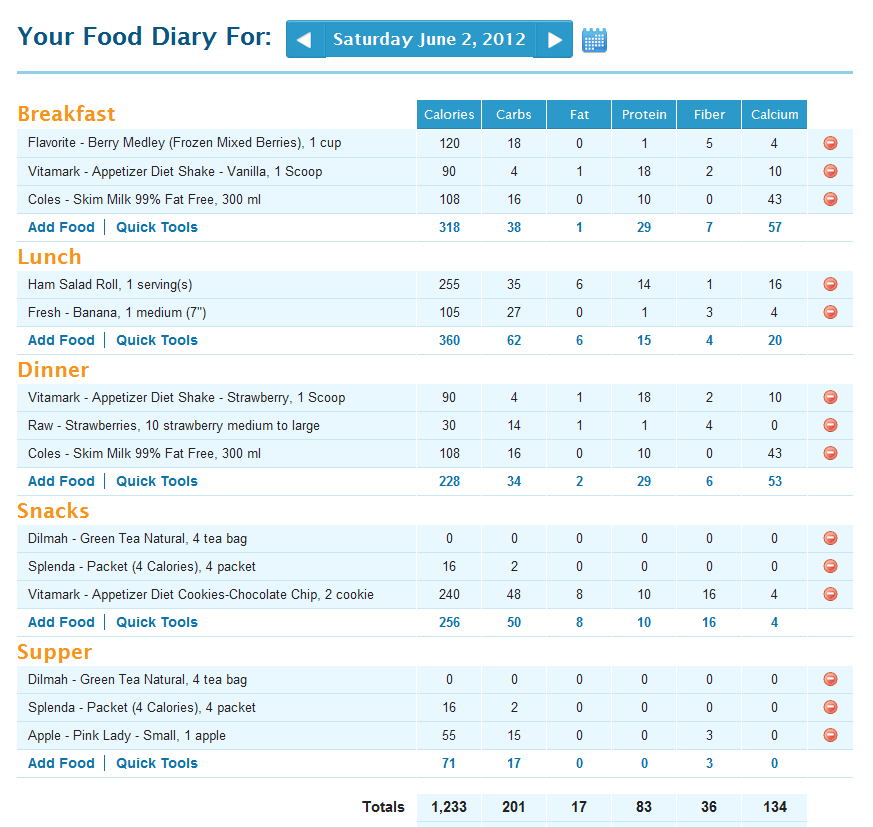
What my 1200 Calorie Diet looks like


Breakfast – 280

Lunch – 310

Snacks – 300

Dinner – 290

Supper (I normally just have a cup of green tea, but will have a piece of fruit if my numbers are low)

How Bad is Fructose? David Despain Interviews Dr. John Sievenpiper

In my article "Is Sugar Fattening?", I discussed a recent review paper on fructose, by Dr. John Sievenpiper and colleagues (1).  It was the most recent of several review papers to conclude that fructose is probably not inherently fattening in humans, but that it can be fattening if it's consumed to excess, due to the added calories.  Dr. Sievenpiper and colleagues have also written other papers addressing the metabolic effects of fructose, which appear to be fairly minor unless it's consumed to excess (2, 3, 4, 5).  The senior author on these studies is Dr. David Jenkins at McMaster University.  David Despain, a science and health writer who publishes a nice blog called Evolving Health, recently interviewed Dr. Sievenpiper about his work.

It's an interesting interview and very timely, due to the recent attention paid to fructose in the popular media. This has mostly been driven by a couple of high-profile individuals-- an issue they discuss in the interview.  The interview, recent papers, and sessions at scientific conferences are part of an effort by researchers to push back against some of the less well founded claims that have received widespread attention lately.

Read more »

Sneaky Causes of Overeating


The meals we know and love need an overhaul, according to the latest dietary guidelines. Fast foods, the "empty" calories in desserts, sweet drinks, and more have helped to fatten the nation -- making two-thirds of adults overweight or obese. Yet, the solution is within reach: Know the worst offenders, substitute better foods, and use a few portion-control tricks -- pictured in the slides to come.


Secrets of Healthy Eating and Portion Control


All the best in Health and Fitness
~ Sue
XXX OOO

Lower Blood Pressure Naturally

Recently, Chris Kresser published a series on dietary salt (sodium chloride) and health (1).  One of the issues he covered is the effect of salt on blood pressure.  Most studies have shown a relatively weak relationship between salt intake and blood pressure.  My position overall is that we're currently eating a lot more salt than at almost any point in our evolutionary history as a species, so I tend to favor a moderately low salt intake.  However, there may be more important factors than salt when it comes to blood pressure, at least in the short term. 

Read more »

Beyond Ötzi: European Evolutionary History and its Relevance to Diet. Part III

In previous posts, I reviewed some of the evidence suggesting that human evolution has accelerated rapidly since the development of agriculture (and to some degree, before it).  Europeans (and other lineages with a long history of agriculture)  carry known genetic adaptations to the Neolithic diet, and there are probably many adaptations that have not yet been identified.  In my final post in this series, I'll argue that although we've adapted, the adaptation is probably not complete, and we're left in a sort of genetic limbo between the Paleolithic and Neolithic state. 

Recent Genetic Adaptations are Often Crude

It may at first seem strange, but many genes responsible for common genetic disorders show evidence of positive selection.  In other words, the genes that cause these disorders were favored by evolution at some point because they presumably provided a survival advantage.  For example, the sickle cell anemia gene protects against malaria, but if you inherit two copies of it, you end up with a serious and life-threatening disorder (1).  The cystic fibrosis gene may have been selected to protect against one or more infectious diseases, but again if you get two copies of it, quality of life and lifespan are greatly curtailed (2, 3).  Familial Mediterranean fever is a very common disorder in Mediterranean populations, involving painful inflammatory attacks of the digestive tract, and sometimes a deadly condition called amyloidosis.  It shows evidence of positive selection and probably protected against intestinal disease due to the heightened inflammatory state it confers to the digestive tract (4, 5).  Celiac disease, a severe autoimmune reaction to gluten found in some grains, may be a by-product of selection for protection against bacterial infection (6).  Phenylketonuria also shows evidence of positive selection (7), and the list goes on.  It's clear that a lot of our recent evolution was in response to new disease pressures, likely from increased population density, sendentism, and contact with domestic animals.

Read more »

Avengers Workout: How to Get Superhero Fit


How did the actors in "The Avengers" get their superhero 
physiques? 3 celebrity trainers dish their secrets.


The Avengers are superheroes, but the actors who play them are not. So how did they achieve their amazing onscreen physiques? Through intense workouts, not special effects.

All the best in Health and Fitness
~ Sue
XXX OOO


Beyond Ötzi: European Evolutionary History and its Relevance to Diet. Part II

In previous posts, I described how Otzi was (at least in large part) a genetic descendant of Middle Eastern agriculturalists, rather than being purely descended from local hunter-gatherers who adopted agriculture in situ.  I also reviewed evidence showing that modern Europeans are a genetic mixture of local European hunter-gatherers, incoming agricultural populations from the Middle East, neanderthals, and perhaps other groups.  In this post, I'll describe the evidence for rapid human evolution since the end of the Paleolithic period, and research indicating that some of these changes are adaptations to the Neolithic (agricultural/horticultural/pastoral) diet.

Humans have Evolved Significantly Since the End of the Paleolithic

Evolution by natural selection leaves a distinct signature in the genome, and geneticists can detect this signature tens of thousands of years after the fact by comparing many genomes to one another.  A landmark paper published in 2007 by Dr. John Hawks and colleagues showed that humans have been undergoing "extraordinarily rapid recent genetic evolution" over the last 40,000 years (1).  Furthermore:
Read more »